


To the babies and grandbabies - this is for you.
It's not easy to change generational patterns. I've heard the pointed stories like "Back in my day..." or "When I was your age." For example, "Back in my day, we walked two miles to school uphill" or "When I was your age, I put myself through college by working two jobs," or "We used to start and retire from the same company. What happened to loyalty?" All of these things, although true, are what they are. Anecdotes of a different time. Times that were better and worse, just in different ways. Do you remember, back in the day, when we had a McDonald's dollar menu, Skyline coneys were $0.79, Buffalo Wild Wings sold $0.10 wings on Tuesdays, but it took ten minutes for dial-up internet to incessantly sputter, beep, and then connect?
These anecdotes exist to serve a point, usually about work ethic, discipline, or my personal favorite to argue with, money. When it comes to money, these anecdotes can actually hold us back. I've heard people say that they paid for college or bought their first car, so they expect their children to do the same. They want to instill the "pull yourself by your own bootstraps" mentality, which while it has its merits and anyone who knows me, knows that I don't disagree, it doesn't account for the dynamic economy, wages and living expenses disaparity, and multitude of existing strategies out there to make a legacy for the next generation. What I'm saying is that now that I'm this age, I recognize that it's a disservice to expect the same buying and saving patterns from our youth in a boldy different world.
Key take-away here: I want older generations to understand that what worked for them regarding financial procurement and confidence may not work for the next generation, and if parents and grandparents understand that and still decide that saving for their children isn't one of their top financial goals or even a financial possibility, then there's no judgement here. To me, that's informed prioritization of family goals, not deflated expectations in an inflated market, and there are ways to help them do it themselves.
Whether you're a parent, relative, or someone who wants to help a young person get a financial head start, take some time to learn what's out there and intentionally decide on your strategy to help kids or help kids help themselves!
The Power of Early Investing
Anyone around young ones knows that time may be the most valuable asset a family has, and financially speaking, time is still the most valuable asset. Timing investments early can significantly increase the long-term impact because compound growth is extraordinary. While many people think of "starting early" as investing in their twenties, have you ever thought about what it looks like for kids?
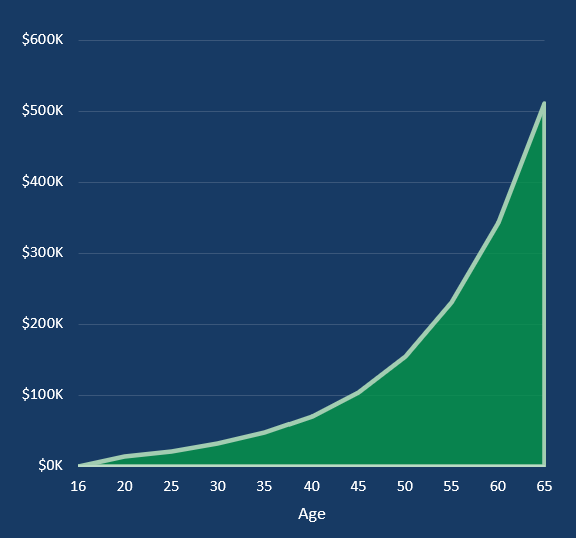
The rule of 72 is a mathematical concept that estimates that at 8% returns, money doubles roughly every 9 years.1 A child born today has 7 or more doubling periods before retirement. That means even a small amount invested at birth has enormous growth potential. Consider even a 16-year old teenager, funding his/her own future, earns $3,000 from a summer job four years in a row and contributes that money to a Roth IRA. Assuming an 8% average annual return, that single contribution could potentially grow to more than $500,000 by retirement, all tax-free. That's the power of starting early with tax-free compounding, but how many 16-year olds do you know have a Roth IRA? That's where a good financial advisor comes in to make recommendations based on your individual circumstances, timeline, and needs.
So let's go on a walk... it may be uphill... through some investment vehicles for kids because one of the biggest obstacles to breaking generational patterns is simply financial literacy. Stay with me! In this, I'll provide an overview of options out there:
- Roth IRA for Minors
- UTMA and UGMA Custodial Accounts
- 529 College Savings Plans
- US Savings Bonds
- Trump Accounts
- Coverdell ESAs
Roth IRA for Minors
For teenagers with earned income, a custodial Roth IRA can be one of the most powerful long-term wealth-building tools available.2
Requirements
- The child must have earned income
- Earned income may come from a W-2 job, self-employment activities such as babysitting or lawn mowing, or even modeling and acting income
- The 2026 contribution limit is $7,500 or the child's earned income, whichever is less
- There is no age minimum
- A parent serves as custodian until the child reaches the age of majority
Benefits
- Tax-free growth for decades
- Qualified withdrawals of earnings can be tax-free
- Potential uses include retirement with some limited withdrawals for first-home purchases, education expenses, and certain medical or disability-related situations
- The account is not counted on FAFSA
- It provides an opportunity to build financial literacy early
Many families use a gift-matching strategy. For example, if a teenager earns $3,000 from a summer job, a parent can gift $3,000 to the child, allowing them to fund the Roth IRA with a gift while still keeping their paycheck for spending purposes.
The primary drawback is that once the child reaches the age of majority, which varies by state, they gain full control of the account and its investments.
Bottom line: For teens with earned income, a Roth IRA introduces retirement investing early and maximizes the benefit of decades of tax-free growth.
UTMA and UGMA Custodial Accounts
UTMA and UGMA accounts offer some of the greatest flexibility among investment options for minors.
Key Features
- Custodians manage investments until the child reaches the age of majority
- No contribution limits exist, although larger gifts may trigger gift-tax reporting requirements
- Contributions are irrevocable and cannot be taken back
- Funds may be used for any purpose
- UTMA accounts can hold assets such as real estate, art, patents, and securities
Considerations
These accounts allow funds to be used for education, a vehicle, starting a business, or virtually any other purpose. However, they come with tradeoffs.
The accounts are subject to kiddie tax rules, and they receive less favorable treatment under FAFSA. UTMA and UGMA accounts are considered student assets, with a significantly higher assessment rate than parent-owned assets such as 529 plans. For families expecting to seek need-based financial aid, that distinction can be important.
529 College Savings Plans
The 529 plan remains one of the most widely used education savings vehicles available.3
Key Advantages
- Tax-free growth
- Tax-free withdrawals for qualified education expenses
- No income limits for contributors
- High lifetime contribution limits, often ranging from $300,000 to $500,000 or more depending on the state
- Favorable FAFSA treatment
Historically, many families viewed 529 plans solely as college savings accounts. Recent legislative changes have expanded their flexibility considerably, such as:
- Funds may be used for eligible trade schools, vocational schools, and registered apprenticeship programs
- SECURE 2.0 allows certain unused funds to be rolled into a Roth IRA that belongs to the 529 beneficiary (up to $35,000 per beneficiary)
- The annual K-12 withdrawal limit increased from $10,000 to $20,000
SECURE 2.0 creates a tax-free retirement pathway for unused education savings and reduces concerns about overfunding a 529 plan, and here's a pro tip: open a 529 as early as possible, even before the child is born by naming a parent as the initial beneficiary. The 15-year clock starts at account opening, not at the child's birth. Opening an account early may provide greater flexibility later.
I would summarize the latter three investments vehicles briefly as follows:
U.S. Savings Bonds
The conservative option, so for those risk-averse.4
- I Bonds offer inflation protection.
- EE Bonds are guaranteed to double in value after 20 years
- Up to $10,000 per type may be purchased per person each year
- Interest may be tax-free when used for qualified higher education expenses
Trump Accounts
These accounts are available to qualifying U.S. citizen children.
- Eligible newborns born between 2025 and 2028 receive a $1,000 contribution
- Parents or employers may contribute up to $5,000 annually
- Withdrawals are generally unavailable before age 18
- After age 18, Traditional IRA-style rules apply (Traditional IRA rules are different than Roth IRA)
- Unfavorable under FASFA - will work against you!
Coverdell ESAs
Coverdell Education Savings Accounts offer:
- Tax-free growth
- Eligibility for both K-12 and higher education expenses
- Broader investment choices than many 529 plans
- A $2,000 annual contribution limit
Funds generally must be used by age 30, and with the restrictions, I haven't found a situation yet where I've recommended over a 529, so a Top Five overview would look something like this...
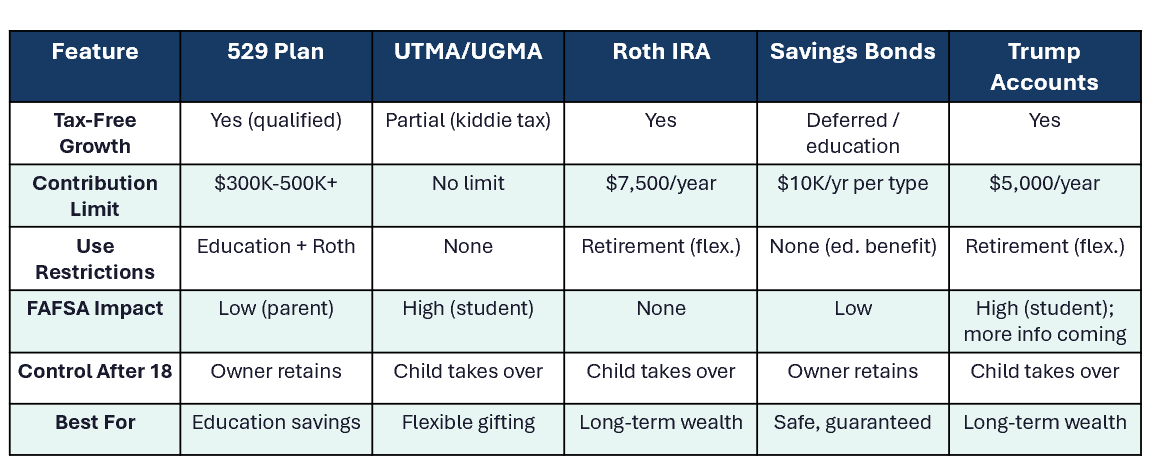
For many families, the best solution is not choosing a single account type. Instead, layering a couple accounts can help maximize flexibility, tax efficiency, and financial aid positioning. A common strategy involves combining a 529 plan for education savings with a custodial Roth IRA for long-term wealth building.
Final Thoughts
The most important action for those with the want and the will is often the simplest: start early and/or teach early. Every family's situation is different, and the right strategy depends on your income, estate size, financial aid expectations, and long-term goals. I'm happy to build a personalized plan for all ages so that one day, my clients can say, "Back in my day, I made a really good decision."
1The rule of 72 is a mathematical concept and does not guarantee investment results nor functions as a predictor of how an investment will perform. It is an approximation of the impact of a targeted rate of return. Investments are subject to fluctuating returns and there is no assurance that any investment will double in value. This is a hypothetical example and is not representative of any specific situation. Your results will vary. The hypothetical rates of return used do not reflect the deduction of fees and charges inherent to investing.
2A Roth IRA offers tax deferral on any earnings in the account. Qualified withdrawals of earnings from the account are tax-free. Withdrawals of earnings prior to age 59 ½ or prior to the account being opened for 5 years, whichever is later, may result in a 10% IRS penalty tax. Limitations and restrictions may apply.
3Prior to investing in a 529 Plan investors should consider whether the investor's or designated beneficiary's home state offers any state tax or other state benefits such as financial aid, scholarship funds, and protection from creditors that are only available for investments in such state's qualified tuition program. Withdrawals used for qualified expenses are federally tax free. Tax treatment at the state level may vary. Please consult with your tax advisor before investing.
4Series I bonds are guaranteed by the US government as to the timely payment of principal and interest and offer a fixed rate of return and fixed principal value. Minimum term of ownership applies. Early redemption penalties may apply. Government bonds and Treasury bills are guaranteed by the US government as to the timely payment of principal and interest and, if held to maturity, offer a fixed rate of return and fixed principal value.
The opinions voiced in this material are for general information only and are not intended to provide specific advice or recommendations for any individual. No strategy assures success or protects against loss. This information is not intended to be a substitute for specific individualized tax or legal advice. We suggest that you discuss your specific situation with a qualified tax or legal advisor.